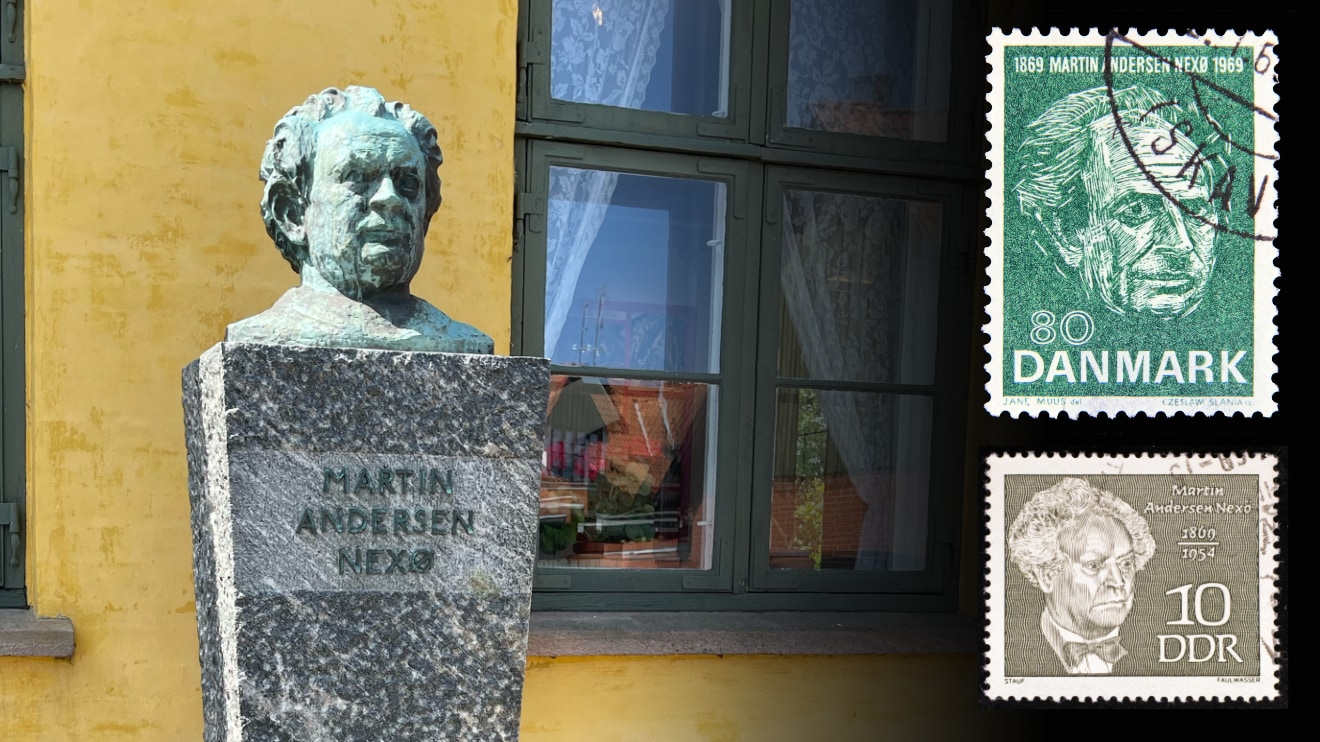
Martin Andersen Nexø (1869–1954) is one of Denmark's best-known writers internationally. His extensive body of work spans more than half a century and includes novels, short stories, travel writing, memoirs, poetry and works of social criticism.
His novels Pelle the Conqueror and Ditte in particular brought him recognition far beyond Denmark. Yet his literary output encompasses much more than these two major works.
Bornholm played an important role in his life and writing. He grew up in Nexø, and his childhood and youthful experiences on the island left a lasting impression on his stories.
Here you will find an overview of Martin Andersen Nexø's most significant books, arranged by literary genre. The years refer to the original Danish book publications. Where no verified English edition title is available, the Danish original title is retained.
Novels
Martin Andersen Nexø's novels explore people's living conditions, social inequality and the struggle for a better life. His stories often focus on those from the poorest sections of society, portraying their hardships, dreams and hopes for the future.
Pelle the Conqueror (1906–1910)
Pelle the Conqueror is Martin Andersen Nexø's best-known novel and one of the great classics of Danish literature.
The novel follows Pelle and his father, Lasse, who leave Sweden for Bornholm in search of a better life. The story begins with Pelle's childhood in the countryside and follows him through his youth and into the labour movement in Copenhagen.
The work portrays poverty and social injustice while also telling a story of human strength, solidarity and hope.
The novel's four volumes:
- 1906 – Boyhood
- 1907 – Apprenticeship
- 1909 – The Great Struggle
- 1910 – Daybreak
The novel gained renewed international attention through Bille August's 1987 film adaptation.
Ditte (Ditte Menneskebarn, 1917–1921)
Ditte, originally published in Danish as Ditte Menneskebarn, is Martin Andersen Nexø's other major novel. It tells the story of a poor girl named Ditte, who grows up in difficult circumstances and is forced to take considerable responsibility for others from an early age.
The novel depicts the lives of women and children around 1900. Through Ditte's experiences, Nexø portrays a society marked by profound social divisions, but also by compassion and humanity.
The five original Danish volumes:
- 1917 – En Barndom
- 1919 – Lillemor
- 1919 – Syndefaldet
- 1920 – Skærsilden
- 1921 – Mod Stjærnerne
Morten hin Røde – the autobiographical novels (1945–1957)
In his later years, Martin Andersen Nexø returned to characters and themes from Pelle the Conqueror. In the series centred on Morten hin Røde, readers follow the politically committed writer Morten and encounter Pelle once again, although his development is now portrayed in a more critical light.
The series consists of three volumes:
- 1945 – Morten hin Røde
- 1948 – Den fortabte Generation
- 1957 – Jeanette
Jeanette remained unfinished when Nexø died in 1954 and was published posthumously. The series therefore never received the full conclusion the author had originally intended.
Other novels
- 1899 – Det bødes der for
- 1900 – En Moder
- 1901 – Familien Frank
- 1902 – Dryss
- 1929 – In God's Land (2 volumes; Danish original: Midt i en Jærntid)
These novels demonstrate the breadth of Nexø's writing and his enduring interest in the relationships between individuals and the societies in which they live.
Short stories and tales
Martin Andersen Nexø made his debut as a book author with the short-story collection Skygger in 1898. Even in these early stories, he demonstrates a keen interest in ordinary people's lives, their relationships and the circumstances that shape their existence.
Many of his short stories have connections to Bornholm. Readers encounter fishermen, agricultural labourers, craftsmen and others whose lives had rarely been given a prominent place in literature.
Books containing new stories
- 1898 – Skygger
- 1900 – Muldskud (first collection)
- 1905 – Muldskud. Anden Samling
- 1908 – Af Dybets Lovsang
- 1911 – Barndommens Kyst
- 1913 – Lykken. En Fortælling fra Bornholms Nordland
- 1915 – Under Himmelen den Blaa
- 1918 – Dybhavsfisk
- 1919 – Undervejs
- 1921 – De tomme Pladsers Passagerer
- 1930 – De sorte Fugle
- 1938 – Mod Lyset. En Haandfuld Æventyr og Lignelser
- 1946 – Et Skriftemaal
Several of these books contain both new stories and previously published material. Some works appeared as individual stories rather than conventional short-story collections.
Selected collections and separate editions
- 1913 – Bornholmer-Noveller
- 1919 – Lotterisvensken
- 1922–1926 – Muldskud (3 volumes, collected edition of earlier stories)
- 1944 – Lønningsdag
- 1946 – De tomme Pladsers Passagerer. Skitser og Noveller, volumes 1–2
- 1949 – Lotterisvensken og andre Noveller
- 1954 – Ungdom og andre Fortællinger
These editions consist wholly or partly of stories that had already appeared in print. They should therefore not be regarded as a series of entirely new, independent works.
Bornholm as a source of literary inspiration
Muldskud, Barndommens Kyst and Bornholmer-Noveller are particularly interesting in relation to Bornholm.
In these stories, Nexø portrays people and places on the island that he knew from his childhood and later visits. His descriptions offer a literary insight into life on Bornholm around 1900 and the social divisions that characterised society at the time.
Travel writing
Martin Andersen Nexø travelled through several European countries, and his experiences beyond Denmark became an important source of inspiration.
His journeys allowed him to encounter other cultures and social conditions. His travel writing combines personal observations, descriptions of places and reflections on social and political issues.
Publications
- 1903 – Days in the Sun (Danish original: Soldage)
- 1923 – Mod Dagningen. Skildringer fra Rusland
- 1934 – To Verdener. Tanker og Indtryk fra en Ruslandsrejse
Days in the Sun draws on his experiences in Spain and offers a vivid picture of the people, landscapes and everyday life of southern Europe.
His later journeys to Russia were closely connected to his political commitment and his interest in the major social changes taking place at the time.
Memoirs
During the 1930s, Martin Andersen Nexø published four volumes of memoirs in which he recounts his childhood, youth and development towards becoming a writer.
These memoirs provide a personal insight into the experiences and people who helped shape his outlook on life and his literary work.
The four volumes of memoirs
- 1932 – Et lille Kræ
- 1935 – Under aaben Himmel
- 1937 – For Lud og koldt Vand
- 1939 – Vejs Ende
The memoirs begin with his early childhood in Copenhagen and follow the family's move to Bornholm, where he grew up in modest circumstances.
He writes about his schooling, work and encounters with people from different sections of society. His experiences as a young man on Bornholm had a profound influence on the writer he would later become.
For readers interested in Bornholm's history, the memoirs are a particularly valuable part of his writing. They should, however, also be understood as literary memoirs in which the author looks back on his own life and interprets his experiences.
Poetry, drama and social commentary
Martin Andersen Nexø was not only a novelist and short-story writer. He also wrote poetry, plays, speeches and articles addressing social issues, culture and politics.
He was politically active for much of his life, and his views were clearly expressed in many of these writings.
Selected book publications
- 1915 – Folkene paa Dangaarden (play)
- 1926 – Digte
- 1945 – Breve til en Landsmand
His political commitment was closely linked to the social issues that also shaped his fiction.
In addition to the books listed above, he published numerous speeches, opinion pieces and articles over the years. These form a significant part of his overall body of work but are not listed individually in this overview.
Publications after Martin Andersen Nexø's death
Martin Andersen Nexø died in 1954, but his literary works have continued to appear in new editions and collections.
Some of these publications bring together previously published texts, while others contain letters, unpublished manuscripts or scholarly edited editions of his works.
Selected later publications
- 1954–1955 – Taler og Artikler (3 volumes)
- 1955 – Lykken og andre Fortællinger
- 1972 – Breve (3 volumes)
- 1979 – Rejse i Syden. Et udvalg af rejsebreve
- 1999 – Erindringer (critical edition with commentary)
- 2024 – Fira borrijnholmska storrjer (stories in the Bornholm dialect)
The unfinished novel Jeanette, which concludes the series about Morten hin Røde, was also published posthumously in 1957.
The years given here refer to the publication dates of the particular editions, not necessarily to when the texts were originally written.
Nexø's works have also been translated into many languages, and several of his major books remain available in both older and more recent editions.
A writer of international significance
Martin Andersen Nexø's books have reached readers far beyond Denmark. Pelle the Conqueror and Ditte, in particular, have enjoyed wide international circulation.
His stories of poverty, social inequality and people's struggle for a better life have established his writing as an important part of both Danish and international working-class literature.
His works are also an important part of Bornholm's cultural heritage. Through Nexø's books, we gain an insight not only into his life and ideas but also into the people, places and social conditions that shaped the island during his childhood and youth.
Visit the Martin Andersen Nexø Museum
If you would like to learn more about Martin Andersen Nexø's life and writing, you can visit the Martin Andersen Nexø Museum in Nexø.
The museum has extensive knowledge of the author's life and works and offers visitors the opportunity to explore his story in the surroundings where he grew up.
A visit provides a more personal introduction to his writing. The museum also regularly organises talks and other activities exploring Nexø's life, literature and the period in which he lived.
Find out more about the Martin Andersen Nexø Museum on FeelBornholm.
Sources and further reading
This article draws on bibliographical and literary-historical sources, as well as material from the Martin Andersen Nexø Museum, whose research and educational work contribute valuable knowledge and understanding of the author's life and writings.
- Martin Andersen Nexø Museum – Liv og værk (in Danish)
- Martin Andersen Nexø – Bibliography (2024, in Danish)
- Lex – Martin Andersen Nexø (in Danish)
- Forfatterweb – Bibliography (in Danish)
- Danish Authors' Biographical Dictionary – Bibliographical records (in Danish)
- The Society for Danish Language and Literature – Tekstnet (in Danish)
About the book list: This overview includes significant individual book publications and a selection of later editions. It is not a complete bibliography of every short story, article, speech, separately printed work, reissue or translation. Historical Danish spellings have generally been retained in the original book titles.